
An electric fuel pump is a small DC motor-driven device that delivers fuel efficiently to the engine. It consists of three main parts: a permanent magnet DC motor, a pump body, and an outer casing. These pumps are essential for maintaining consistent fuel flow in vehicles.
So, what are the types of fuel pumps?
Usually, we can divide it based on 2 parameters: Installation Location and Internal Structure
Based on Installation Location
In-tank (Internal) Fuel Pump:
Installed inside the fuel tank, it offers low noise because it is inside the fuel, preventing vapor lock, reducing leakage risk, and simplifying fuel line installation. It’s commonly used in modern vehicles for quiet, efficient fuel delivery.

External Fuel Pump:
Mounted outside the fuel tank, it is easier to install and maintain but:
- Noisier: It makes more noise when working.
- Higher vapor lock risk: Air can form in the fuel lines, causing problems.

Based on the Internal Structure
Electric fuel pumps can also be categorized by their internal mechanisms:
- Turbine Fuel Pump: The turbine design is popular in internal fuel pumps because it is compact and efficient. It uses turbine blades inside to push fuel to the needed high pressure.
- Roller Fuel Pump: The roller design is commonly used in external pumps. It uses small balls or pistons to move fuel, making it useful for vehicles with less space.
- Rotor Fuel Pump: This type uses a rotating rotor to push fuel. It’s known for being durable and reliable.
- Side Channel Fuel Pump: The side trough design pushes fuel to high pressure and is made for specific vehicle needs or applications.
The two most commonly used types are turbine-type and roller-type electric fuel pumps. Let us keep studying their details.
Turbine-Type Electric Fuel Pump
Turbine fuel pumps are predominantly used in in-tank installations, ensuring stable fuel pressure with minimal noise.
Components:
- Electric Motor: Powers the pump and drives the fuel.
- Turbine Pump: Consists of one or two impellers, a casing, and a pump cover.
- Check Valve: Prevents fuel from flowing backward when the pump stops, maintaining residual pressure for easier engine restarts.
- Safety Valve: Protects the system by opening if fuel pressure exceeds the safe limit (typically 343–441 kPa), allowing excess fuel to flow back into the tank.

Operating Principle:
As the electric motor drives the impeller, it pushes fuel from the inlet to the outlet. When the pressure reaches the desired level, the check valve opens, allowing fuel to enter the system. When the motor stops, the check valve closes, retaining some pressure in the system. This ensures quick engine restarts.
Key Features:
- Stable fuel pressure: Ideal for maintaining consistent performance.
- Low noise: Quiet operation without the need for additional shock absorbers.
- Compact design: Suitable for in-tank installations where space is limited.
- Fuel-cooled and lubricated motor: Fuel flowing through the pump helps to cool and lubricate the motor, extending its lifespan.
- Best for low-pressure, high-volume applications: Turbine pumps are perfect for modern vehicles with large fuel flow requirements.
Roller-Type Electric Fuel Pump
The roller-type fuel pump is more commonly used in external installations. It delivers higher pressure but is more noisy and larger.
Components:
- Electric Motor: Powers the roller mechanism.
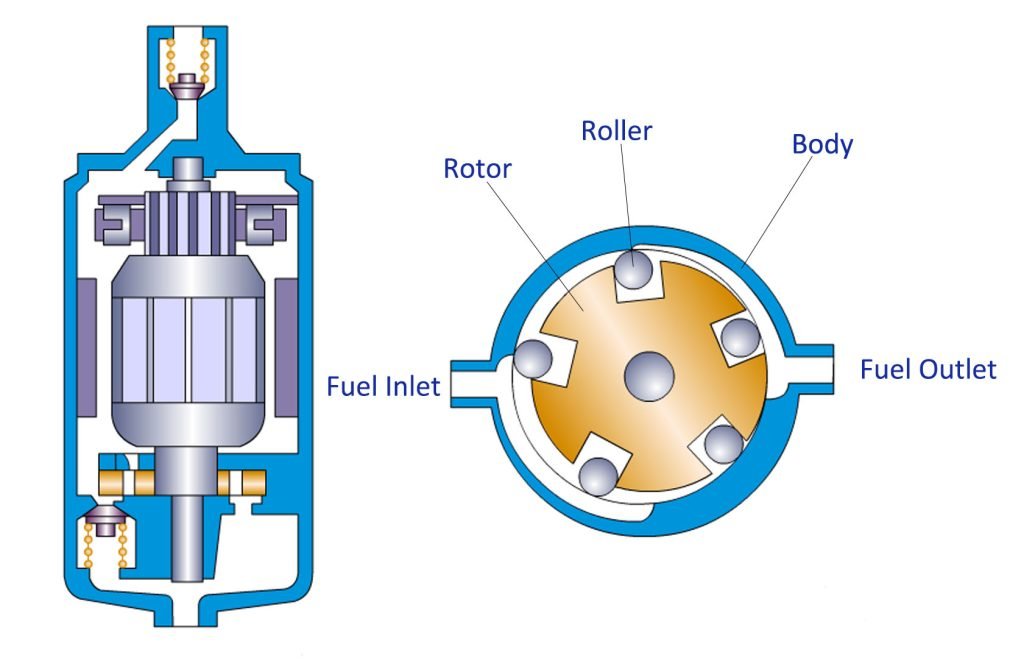
- Roller Pump: Uses rotating rollers that cause internal volume changes to push fuel from the inlet to the outlet.
- Check Valve: Similar to the one used in turbine pumps, it maintains residual pressure after the motor stops.
- Safety Valve: Ensures the system does not exceed the specified pressure limit.
- Damping Shock Absorber: Necessary to smooth out pressure fluctuations and reduce noise.
Operating Principle:
As the rollers rotate, the internal volume of the pump changes. When the volume increases, fuel is drawn into the pump; when the volume decreases, the fuel is pushed out under pressure.
Key Features:
- Higher pressure output: Ideal for engines requiring robust fuel delivery.
- Increased noise: Roller pumps are louder, especially when mounted externally.
- Damping system: Required to reduce pressure fluctuations, which increases the overall size of the pump.
- Perfect for racing and performance applications: higher fuel pressure is necessary for optimal engine performance.
Conclusion
Choosing the right electric fuel pump depends on the installation location and performance requirements. In-tank turbine pumps offer quieter, stable operation, while external roller pumps provide higher pressure but at the cost of more noise and bulk. Selecting the appropriate pump type ensures optimal fuel delivery, improved vehicle performance, and longer pump life.
Whether you’re looking for a reliable pump for a high-performance vehicle or replacing a standard pump, understanding the differences between turbine and roller-type pumps will help you make an informed decision.