
Before discussing throttle body with engine capabibilty, let us clarify a principle concept:
The output capability of an engine depends on its air intake capability.
Under this concept, you can learn more about the racing car engine.

Our modern automobile engine design is an internal combustion engine. This machine uses a series of designs to allow fuel to burn in the cylinder, forming high-temperature and high-pressure gas to push the piston to do work. This process generates high-temperature and high-pressure gases that push the piston to perform work. The engine converts the reciprocating motion of the piston into the rotational motion of the crankshaft, thus producing mechanical energy.
When we talk about “refueling,” we can be misled into thinking that adding more fuel directly boosts engine power. In truth, pressing the accelerator opens the throttle body, allowing a greater air inflow into the engine. It’s this surge of air that signals the engine to ramp up fuel injection. Only then do we experience that exhilarating boost in power. Understanding this process emphasizes the precise mechanics at work and helps us appreciate the engineering behind our vehicles.
What is displacement?
The displacement of an engine is a physical concept that refers to the volume of space within the engine cylinder. Specifically, it measures the physical space between the piston’s top dead center (TDC) and bottom dead center (BDC). This volume is known as the engine’s displacement.
Some believe displacement refers to the “volume of fluid drawn in or expelled per stroke or cycle.” However, from a physics standpoint, this understanding is incomplete. Regarding gases, volume must be considered alongside temperature and pressure.
Displacement is simply a definition of physical space; it does not equate to the actual volume of air inhaled or account for the volume of exhaust gases released after combustion. A straightforward example is that a 2.0T and a 2.0L engine have a displacement of 2.0 liters, yet the 2.0T generates approximately 50% more power than the 2.0L. The key difference lies not in the quantity of oil sprayed by the 2.0T compared to the 2.0L, but in that, the 2.0T intakes 50% more air.

Definition of Filling Coefficient: The filling coefficient represents the air inhaled into the cylinder per cycle, expressed as the volume \(V_1\) under the intake pipe conditions (pressure and temperature). This volume is then compared to the physical displacement of a single cylinder, and the ratio of these two values is termed the filling coefficient.
Definition of Intake Pipe Coefficient: The intake pipe coefficient is derived by converting the air volume under the intake pipe’s conditions (temperature and pressure) to the equivalent volume at ambient atmospheric pressure and temperature. We obtain the intake pipe coefficient by dividing the latter value by the former.
If we relate the ambient atmospheric pressure and temperature to the standard atmospheric pressure and temperature, we can create a consistent link between the volume of fresh air and the quantity of air present. This clarification will help us understand how displacement affects an engine’s ability to perform work. It’s important to emphasize that an engine’s output capacity is determined by its intake capacity.
The intake volume, denoted as V0, is influenced by several factors, including the size of V2 and Vs and the differences between P2 (intake pressure), T2 (intake temperature), and the ambient temperature and pressure.
For a given engine displacement, the amount of air drawn into the cylinder during each cycle is directly related to the intake air temperature (T2) and pressure (P2). Specifically, a lower intake temperature combined with higher intake pressure results in a greater actual intake air volume, which enhances the engine’s performance.
All intake power is derived from the vacuum created during the engine’s intake stroke in naturally aspirated engines. Therefore, it is crucial to design the intake manifold efficiently. Efforts should focus on minimizing intake resistance, maximizing the benefits of intake resonance, and preventing intake pulse interference that can reduce intake efficiency. Typically, engines with a displacement larger than 1.5 liters utilize a variable-length intake manifold for optimization.
This complexity in design explains why naturally aspirated engines often have intricate and sizable intake manifold structures, while supercharged engines tend to have simpler configurations. Supercharged engines benefit from direct supercharging, which reduces the need for extensive airflow research within the intake manifold.
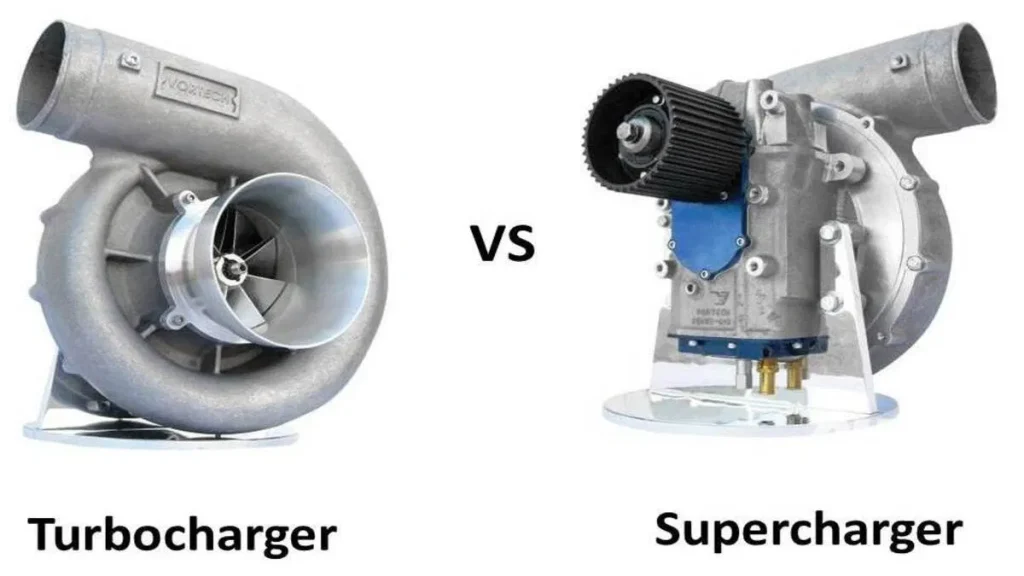
Let’s discuss the control of temperature T2. In simple terms, the goal is to reduce the temperature of the air that is ingested as much as possible to increase its density.
This is particularly important for supercharged engines. When air is drawn in from the environment and compressed by the turbocharger, it is heated by the exhaust gases. This process raises the intake temperature, leading to insufficient intake density and reduced actual intake volume, even if the engine’s volume remains the same. Therefore, cooling the intake air is essential, and this system is known as an intercooler.
Typically, the intercooler used in most engines employs an air-to-air cooling method, utilizing an air-cooled intercooler to lower the intake air temperature. This component is usually located at the front of the vehicle and has a specific design that helps facilitate this cooling process.
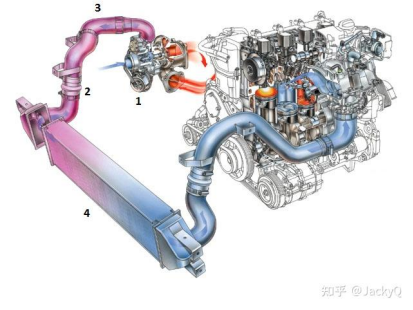
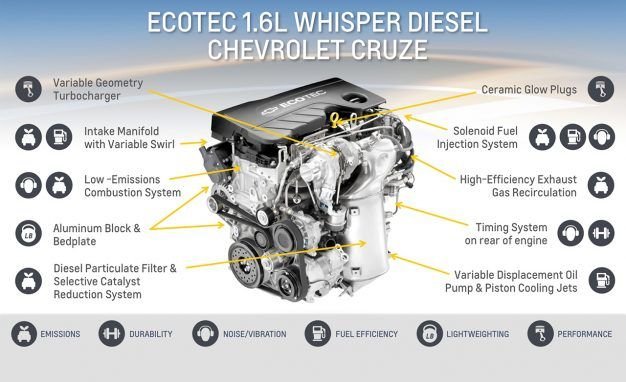
The cooling effect of air is not as practical as water cooling. In recent years, the use of water cooling has significantly increased for high-performance engines, further enhancing torque response. such as Ecotec engine
Let’s summarize:
The displacement of a single cylinder refers to the physical space within the cylinder that the engine piston moves between its up and down strokes. This displacement serves as the foundation for an engine’s intake volume. The actual intake volume can be influenced by several factors, including increasing the pressure, reducing intake resistance, adjusting the intake and exhaust valve profiles, and modifying the timing strategies to alter the adequate intake pressure. Additionally, intake temperature can be managed using intercoolers—the actual intake volume is crucial in determining the engine’s performance.