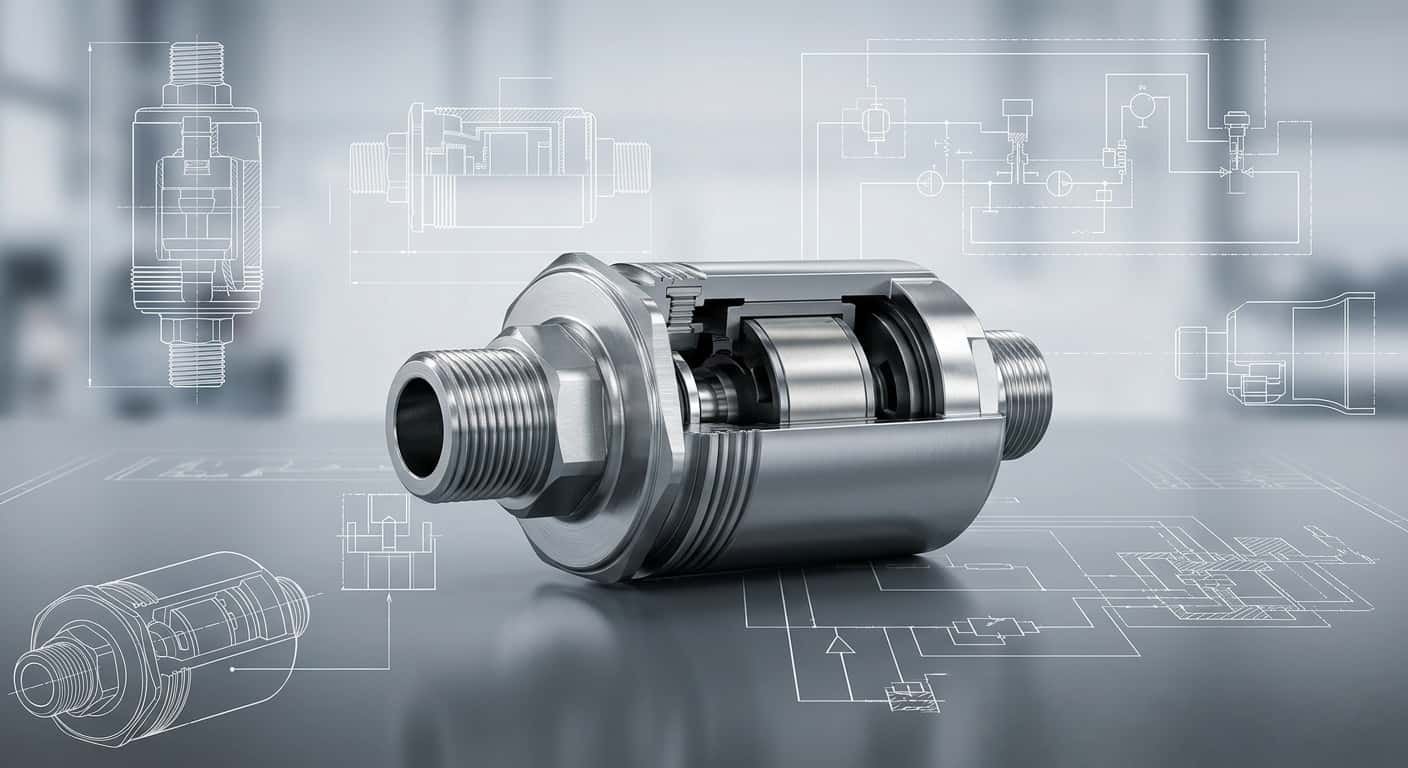

CreditParts modification technology for the mass market – ABS Sensor
ABS sensor is a key component of the automobile anti-lock braking system (ABS)
Main functions of ABS Sensor
Accurately monitor wheel speed:
ABS sensors are generally installed near the wheels to accurately monitor the wheel speed in real time. It converts the mechanical rotation of the wheels into electrical signals through electromagnetic induction or Hall effect principles, and then transmits these signals to the ABS control unit uninterruptedly. For example, under various working conditions such as car start-up acceleration, normal driving, deceleration and braking, the sensor can dynamically capture the changes in wheel speed and provide the most basic data basis for subsequent anti-lock control.
Prevent wheel lock:
This is one of the core functions of the ABS sensor.
During vehicle braking, when the driver steps on the brake pedal, the braking system starts working and the wheel speed will decrease. The ABS sensor will continuously feed back the wheel speed signal to the ABS control unit, and the control unit will calculate the deceleration and slip rate of the wheel based on these signals.
Once it is found that the speed of a wheel drops too fast, the deceleration or slip rate exceeds the normal range, indicating that the wheel is about to lock, the control unit will quickly issue a command to adjust the hydraulic pressure of the wheel brake cylinder, reduce the braking force, and restore a certain rotation of the wheel to avoid locking.
For example, in emergency braking or braking on slippery roads, this function can prevent the wheel from completely locking and maintain the vehicle’s handling performance.
Ensure braking stability and safety:
Since the ABS sensor can independently monitor the speed of each wheel, the ABS system can accurately distribute the braking force according to the actual situation of each wheel. In this way, during braking, the braking force of the four wheels of the vehicle is more balanced, avoiding dangerous conditions such as vehicle tail-swinging, side-slipping, and loss of control caused by locking of a certain wheel, ensuring that the vehicle can still drive according to the driver’s intention during braking, greatly improving the stability and safety of the vehicle during braking, and ensuring the safety of the life of the occupants and the safety of the vehicle and other traffic participants on the road.
Provide data support for other systems:
In addition to playing a key role in the ABS system, the wheel speed information collected by the ABS sensor can also provide important data for other electronic control systems of the vehicle. For example, the electronic stability program (ESP), traction control system (TCS), vehicle dynamic control system (VDC), etc. These systems share ABS sensor data and combine it with their own control strategies to achieve all-round monitoring and precise control of the vehicle’s driving status, further improving the vehicle’s overall performance and safety under various complex road conditions and driving conditions.
How ABS Sensor works
Inductive sensor:
It is composed of magnets and coils. The sensor forms a magnetic circuit with the rotating gear ring. The rotation of the gear ring causes the magnetic field of the coil to change, generating an AC voltage signal that is approximately a sine wave. Its frequency and amplitude are related to the wheel speed. The faster the wheel speed, the higher the signal frequency and the larger the amplitude. It does not require power, but the accuracy is low at low speeds.
Hall sensor:
It is an integration of electronic circuits and magnetic field sensors. It needs to be powered by a controller. When the gear rotates, the density of the magnetic lines of force passing through the Hall element changes, generating a millivolt-level quasi-sine wave voltage signal, which is then converted into a standard pulse voltage by the electronic circuit. Its advantage is that there is no minimum wheel speed limit, and the signal can be measured when the vehicle is started.
Fault manifestation
Instrument warning light on:
When the ABS sensor fails, the ABS fault light, vehicle stability system warning light, traction control system warning light, etc. on the dashboard may light up.
Degraded braking performance:
During emergency braking, the wheels are prone to lock, slip and lose control, the braking distance is extended, the vehicle’s driving stability is reduced, and the vehicle may also deviate or drift when braking, and the steering maneuverability becomes worse.
Pedal abnormality:
The sensor failure sends an erroneous signal, which will cause the control unit to mistakenly trigger the ABS system, causing the brake pedal to pulsate and rebound.
Other systems affected:
In some vehicles, the sensor failure will also cause the electronic power steering system, speedometer, etc. to fail, such as the speedometer stopping display.

Replace the ABS sensor steps:
Confirm the faulty sensor:
Read the fault code through the diagnostic instrument to determine which wheel’s ABS sensor is faulty. You can also observe the vehicle’s fault performance, such as a wheel that is prone to locking during braking, to preliminarily determine the faulty wheel.
Prepare tools and accessories:
Common tools include wrenches, sockets, screwdrivers, etc. At the same time, prepare a new ABS sensor that matches the vehicle model.
Vehicle preparation:
Park the vehicle on a flat and safe ground, pull the handbrake, and start the warning light to prevent collision with other vehicles. If it is a manual transmission vehicle, shift the gear to 1st gear or reverse gear; if it is an automatic transmission vehicle, shift the gear to P gear.
Remove the tire:
Use a socket wrench to loosen the tire bolts, then use a jack to lift the vehicle to a certain distance from the ground, then remove the tire and place it properly.
Remove the old sensor:
Find the installation location of the ABS sensor, which is generally located on the wheel hub near the wheel. First disconnect the electrical plug of the sensor. Usually the plug has a snap or locking device, which needs to be pressed or pulled open before it can be separated. Then use a suitable tool, such as a wrench or screwdriver, to remove the bolts or nuts that secure the sensor and remove the old sensor from the mounting bracket.
Install the new sensor:
Install the new ABS sensor to the original position and secure it with bolts or nuts. Be careful to install it firmly to avoid loosening. Then connect the electrical plug and make sure that the plug is plugged in tightly and the buckle or locking device is working properly.
Install the tire:
Install the removed tire back on the vehicle and tighten the tire bolts in a diagonal order. First tighten it initially, then lower the jack so that the vehicle tire is on the ground, and then use a socket wrench to tighten the tire bolts to the specified torque.
Check and test:
Check that all installation parts are firm and the electrical plugs are connected correctly. Start the vehicle and observe whether the ABS fault light on the dashboard is off. If the fault light is still on, you may need to use a diagnostic tool to clear the fault code and test the system to ensure that the newly installed ABS sensor is working properly.

#change
At the end of the article, we wish every car lover a wonderful car modification career.
If you are interested in purchasing auto parts, please feel free to contact us.
CreditParts will always be your best car navigator.